
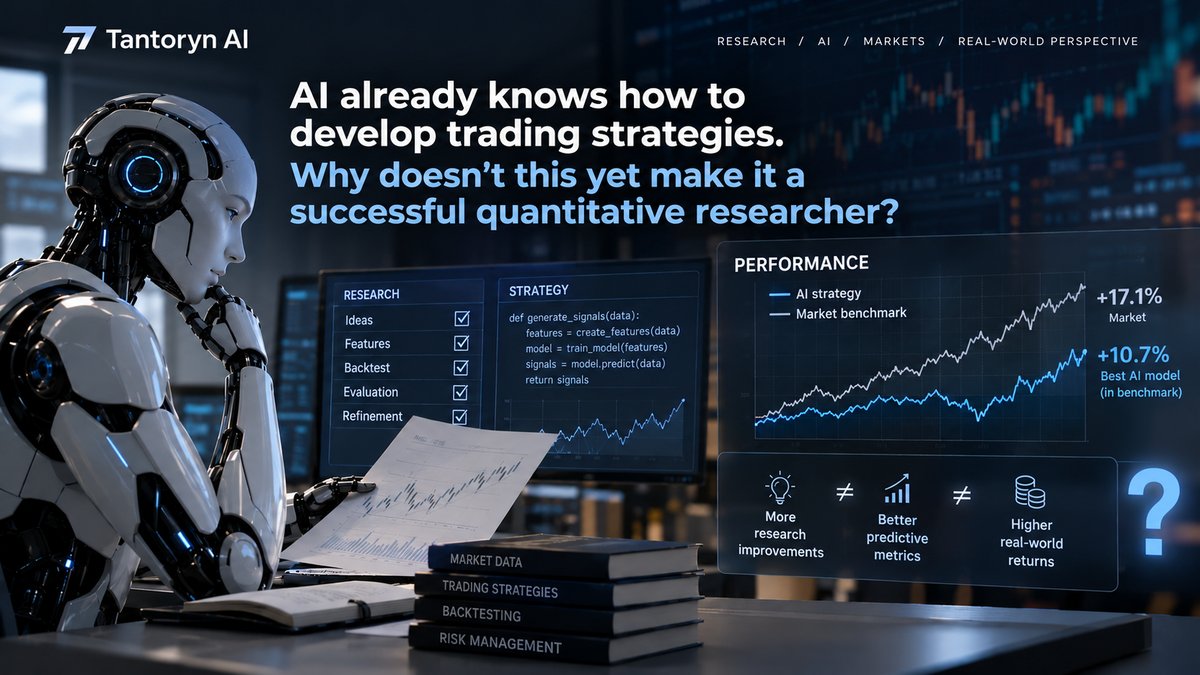
Artificial intelligence can build trading hypotheses, train models and analyze experiment results. Yet a successfully completed computation does not mean that a useful market pattern has been discovered.
In October 2026, this problem showed up in Tantoryn AI's own research. We were testing new approaches to finding trading patterns, obtained negative results, and uncovered an error in data preparation.
These events matter not because they led to a new trading strategy, but because they showed which results cannot be accepted without additional verification.
What we were researching
In early October, the work was in the ML Setup Discovery direction. Its goal is to explore whether machine learning can identify trading patterns from descriptions of market state.
This direction differs from Tantoryn AI's existing deterministic trading families, where the conditions for forming candidates are defined by preset rules. ML Setup Discovery investigates a different question: can a model discover additional patterns in historical market states?
For that, a good training metric is not enough. It must be established that the discovered dependence holds beyond the research sample, does not arise from quirks of data preparation, and has sufficient grounds for further consideration. The most important results emerged precisely at these checks.
First result: a trained model does not yet mean a discovered pattern
During the October experiments, several research candidates passed the prescribed training and technical validation stages. But completing the computations did not become grounds for accepting them.
In some cases, the results did not allow a well-founded decision on how to use the scores the model produced. In others, the available evidence was insufficient to consider the discovered pattern stable. Such candidates were not admitted to further use.
This is a negative research result, not a technical training failure. A model can correctly finish its run, produce predictions and obtain measurable metrics, yet fail to provide convincing evidence that those predictions are useful for trading decisions. That is the difference between successfully executing an experiment and confirming a research hypothesis. We described the first outcomes of these checks in a separate report.
For Tantoryn AI this distinction is fundamental: the mere fact that a model has been trained is not a sufficient basis for changing the trading system.
Second problem: checks completed without usable data
The more significant technical problem appeared in data preparation. Some checks formally completed successfully even though the data prepared for the corresponding evaluation contained no usable observations.
That meant a successful technical status could not be interpreted as confirmation of model quality. The program would report a completed check while no actual basis for a positive research conclusion existed.
The error was not that the model showed a weak result — it was that a check could complete without enough data to evaluate it. After the problem was discovered, the data preparation had to be fixed and the corresponding results re-verified.
This case revealed an important requirement for research infrastructure. It is not enough to check only for the absence of software errors. It must also be separately established that the prepared data actually contain usable observations; that the check ran on the intended sample; that the resulting metrics have a definite meaning; and that completing a procedure does not substitute for confirming a research result. Otherwise automation creates a false sense of reliability.
Why good research metrics can mislead
A similar problem is examined in the study Quant-Arena: Benchmarking LLM Agents for Quantitative Trading Research, published on October 21. Its authors tested nine language models capable of independently developing and improving quantitative trading strategies on the stock market.
When the models were allowed to revise their solutions step by step, the average research score rose. Yet the financial outcome improved for only four of the nine models — and got worse for the other five. In other words, a more successful research process did not necessarily lead to a more effective strategy.
An extended discussion of this experiment is being prepared for publication on HackerNoon.
It is important not to conflate the two studies. Quant-Arena examines the ability of language models to conduct quantitative research on their own in the stock market. Our October experiments concerned ML Setup Discovery at Tantoryn AI. They differ in problem formulation, methods and evaluation procedures. The shared problem lies elsewhere: high research metrics and technically completed experiments are not sufficient proof of a model's economic value.
Why we keep research, evaluation and risk management separate
At Tantoryn AI, the search for trading patterns, the validation of research candidates and risk management are treated as different tasks. A research result must pass the prescribed evaluation before there are grounds to discuss its further use.
This is especially important in machine learning. A model may detect a statistical dependence that disappears when market conditions change. It may perform well on the research period yet fail to retain quality on independent data. And even a correct prediction does not guarantee an economic advantage once trading constraints are taken into account.
That is why we do not treat the number of trained models or completed experiments as a progress metric in its own right. A negative result can also be useful when it is obtained correctly and rules out an unjustified decision.
The current public trading loop of Tantoryn AI uses virtual trades. Real-order execution is disabled. Research and virtual-trading results are not proof of profitability with real capital.
What changed in our understanding of the research process
The October experiments allowed us to sharpen two practical requirements.
First: every positive research conclusion must rest on verifiable data. Formal completion of a procedure is not enough. It must be confirmed that the evaluation actually took place and that its result can be interpreted.
Second: a research candidate must carry evidence that matches the intended use. A good training metric does not replace a check of stability and of the result's economic meaning. These requirements do not guarantee that future models will succeed, but they reduce the risk of making decisions on the basis of unreliable or insufficient evidence.
Conclusion
In October, Tantoryn AI gained no grounds to declare the researched ML Setup Discovery candidates new, confirmed trading strategies. Instead, we obtained two practically important results. The first is confirmation that a successfully trained model may lack sufficient evidence of usefulness. The second is the discovery of a data-preparation error in which a technically completed check did not amount to a real evaluation.
These results are consistent with the broader problem that Quant-Arena demonstrates: research automation is advancing faster than our ability to reliably confirm its economic value. For us, developing trading AI is not only about finding new patterns, but also about the ability to promptly reject results that cannot yet be trusted.
This material reflects the research activity of Tantoryn AI. The described results are not proof of the trading system's profitability and are not investment advice.
Sources and related materials
1. Houde Qian et al. Quant-Arena: Benchmarking LLM Agents for Quantitative Trading Research. October 21, 2026. The primary study.
2. Quant-Arena — official project page. Description of the experimental environment and results.
3. Sichun Luo et al. AlphaQT-Bench: Diagnosing the Gap between Financial Code Generation and Quantitative Reasoning in LLMs. Findings of ACL 2026. A study of the gap between executable code and correct financial computations.